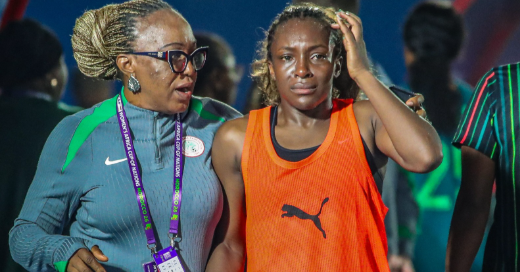

CASABLANCA, Morocco — Nigeria’s Super Falcons have suffered one of the biggest setbacks in the history of the country’s women’s football after losing 2–1 to South Africa in a decisive 2027 FIFA Women’s World Cup qualification play-off on Thursday.
The defeat means Nigeria will miss the Women’s World Cup for the first time since the tournament began in 1991, bringing an end to an extraordinary qualification record that had seen the Super Falcons feature at every edition of the global competition.
The crucial encounter, played at the Moulay Rachid Stadium in Casablanca, came after Nigeria’s disappointing 1–0 quarter-final defeat to Cameroon at the 2026 Women’s Africa Cup of Nations, which denied the team automatic qualification and pushed them into the play-off route.
Both Nigeria and South Africa entered the match under enormous pressure, knowing that another defeat would deal a devastating blow to their World Cup ambitions.
After a tightly contested first half ended goalless, South Africa broke the deadlock in the 56th minute through Thembi Kgatlana, who finished off a swift attacking move to put Banyana Banyana ahead.
Nigeria responded by increasing the pressure in search of an equaliser, but South African goalkeeper Kaylin Swart produced a number of important saves to frustrate the Super Falcons.
The situation became more difficult for Nigeria when South Africa captain Refiloe Jane doubled her side’s lead late in the second half, leaving the Super Falcons with a mountain to climb.
Nigeria were handed a late lifeline deep into stoppage time after a VAR review resulted in a penalty for the Super Falcons and a second yellow card for Jane, reducing South Africa to 10 players.
Substitute Christy Ucheibe converted the penalty to make it 2–1, briefly raising hopes of a dramatic comeback.
The Super Falcons pushed desperately for an equaliser in the closing moments, with Michelle Alozie among those threatening the South African goal, but Swart once again stood firm to preserve the victory for Banyana Banyana.
The final whistle confirmed a painful and historic elimination for Nigeria.
Before Thursday’s defeat, the Super Falcons had qualified for every Women’s World Cup since the inaugural edition in 1991, appearing at the tournaments in 1991, 1995, 1999, 2003, 2007, 2011, 2015, 2019 and 2023.
Nigeria’s absence from the 2027 tournament in Brazil will therefore mark the first time the country will not be represented at the world’s biggest women’s football competition.
The development is expected to raise fresh questions about the direction of the national team, especially given Nigeria’s long-standing dominance of African women’s football and its record as the continent’s most successful national side.
South Africa, meanwhile, remain in contention for a place at the World Cup and will proceed to the next stage of the qualification process.
For Nigerian football supporters, however, the result represents a painful end to a proud global record and one of the darkest moments in the history of the Super Falcons.
Leave a Reply