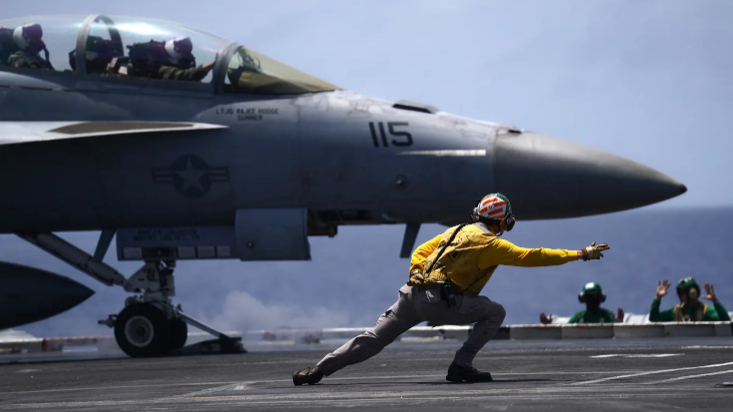

WASHINGTON/DUBAI — The United States military has struck three Iranian oil tankers after Iran’s Islamic Revolutionary Guard Corps allegedly fired ballistic missiles at two U.S. Navy warships, marking a fresh escalation in the months-long confrontation between Washington and Tehran.
U.S. Central Command said Saturday, September 5, that an American aircraft carrier and a guided-missile destroyer came under what it described as multiple unprovoked Iranian attacks while operating in the region. The U.S. military said the vessels avoided the missiles and no American personnel were injured.
In response, American forces attacked three Iranian oil carriers. According to the U.S. military, two of the tankers were permanently disabled, while a third vessel, which was not carrying oil at the time, was destroyed after its crew was directed to abandon ship.
One tanker was struck off Kharg Island, the location of Iran’s main oil export terminal, while another was targeted near Jask, east of the Strait of Hormuz. The third tanker was attacked in the Gulf of Oman. Iranian state media later reported that crews from the affected vessels had been evacuated. Reuters, citing Iran’s semi-official Tasnim news agency, said no casualties were reported in the strike near Kharg Island.
U.S. Central Command alleged that the vessels formed part of a network used to generate revenue for Iran’s Revolutionary Guard and Iranian-backed armed groups across the Middle East. CENTCOM commander Adm. Brad Cooper warned that attacks on American forces would be met with further economic and military consequences. Iran had not issued an immediate formal government response to the U.S. announcement.
The confrontation comes after renewed U.S.-Iran fighting following a period of relative calm. Hostilities have continued intermittently since U.S. and Israeli attacks on Iran began on February 28, while negotiations aimed at resolving the conflict and addressing Iran’s nuclear programme have since faltered.
The latest escalation is also raising concerns over civilian casualties. At least five people were reported killed during U.S. bombardments in southern Iran earlier this week, while one strike hit a wedding gathering. U.S. authorities have said they are investigating reports surrounding the deadly incident.
Strait of Hormuz Remains Critical Flashpoint
The renewed attacks are drawing particular international concern because of the importance of the Strait of Hormuz to global energy markets. Before the current conflict, the waterway carried roughly one-fifth of the world’s oil supply, while Kharg Island handled about 90 per cent of Iran’s crude exports.
The United States has been assisting commercial vessels navigating the strait as Iran seeks greater control over traffic through the strategic waterway. Shipping activity, however, remains significantly reduced amid continuing military risks.
Oil markets have already reacted to the renewed tensions. Brent crude closed Friday at $96.28 per barrel, its highest closing level since July 24, as traders weighed the possibility that further fighting could disrupt energy supplies from the Gulf.
The latest exchange underscores the danger that the U.S.-Iran confrontation could again widen, with military operations increasingly targeting not only military installations but also the economic infrastructure that supports Iran’s government and armed forces.
Associated Press and U.S. Central Command.
Leave a Reply